By
By 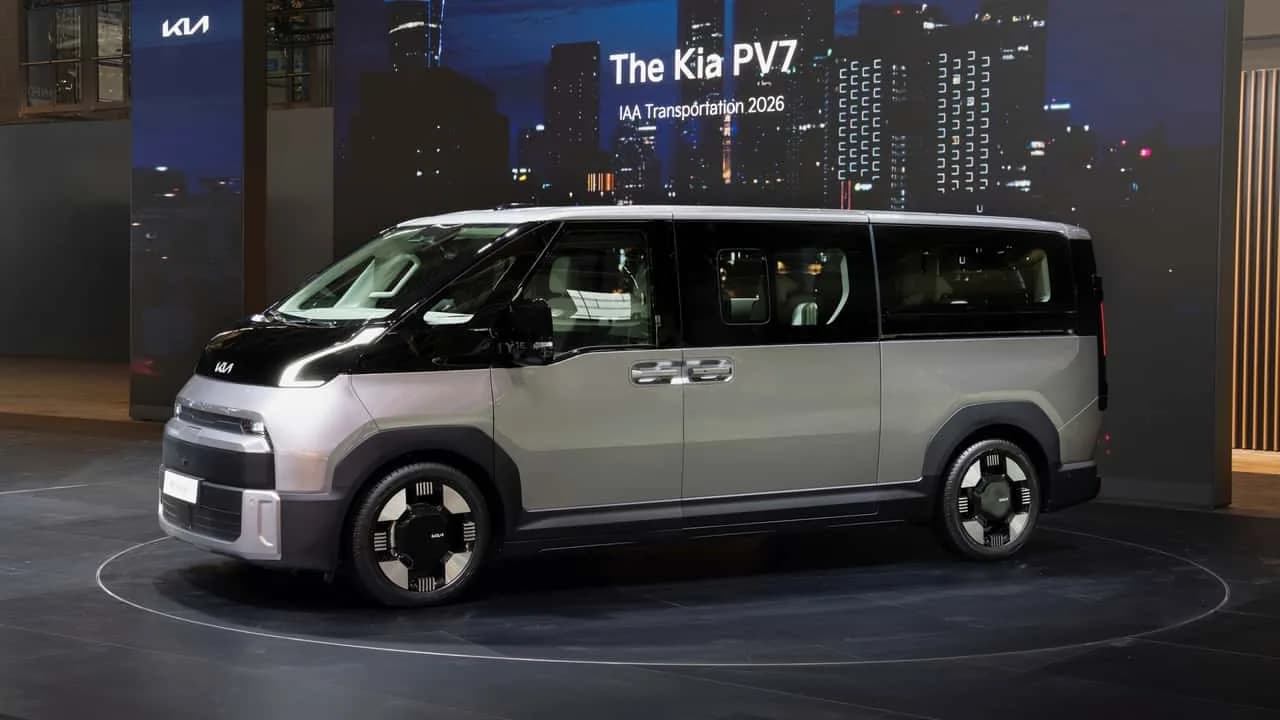
Kia has unveiled the 2027 PV7, a large electric commercial van designed for delivery work, logistics, passenger transport, and specialized conversions. The second model in Kia’s dedicated Platform Beyond Vehicle lineup made its world debut at IAA Transportation 2026 in Hannover, Germany, with the first versions scheduled to reach Korea and Europe in the second half of 2027.
Built on the dedicated E-GMP.S architecture, the PV7 uses a flat floor to maximize interior volume. It measures 17.6 feet (5,350 millimeters) long, 6.5 feet (1,995 mm) wide, and 6.5 feet (1,990 mm) tall, with an 11.5-foot (3,500-mm) wheelbase.
Cargo and passenger configurations
The PV7 Cargo will be available with two or three seats. In Long form, it offers up to 215.4 cubic feet (6.1 cubic meters) of cargo capacity, while the High Roof version increases that figure to 282.5 cubic feet (8.0 cubic meters). Payload capacity reaches 2,646 pounds (1,200 kilograms), depending on configuration.
The Long Cargo model has a 21.7-inch (550-mm) loading height and can carry up to three Euro pallets. Kia will offer multiple cargo-floor layouts, plus a conventional lift-up tailgate or twin-swing rear doors for easier loading in confined spaces.
Passenger models can carry up to nine people, while Korean-market versions will accommodate as many as 11 occupants. The seven-seat layout uses removable seats mounted on long rails. A nine-seat version can be configured with either three or four rows. Rear climate controls, USB-C ports, storage areas, and power-sliding doors are available for passengers.
Battery, range, and charging
Kia will offer the PV7 with 71.5-kWh and 96.2-kWh NCM battery packs. The front-wheel-drive powertrain produces up to 268 horsepower and 310 lb-ft (420 Nm) of torque. An all-wheel-drive version is planned for a later date.
The Long Range Cargo model with the larger battery is expected to travel more than 286 miles (460 kilometers) on the WLTP cycle. Its 800-volt electrical system can charge the battery from 10 to 80 percent in the mid-20-minute range when connected to a 350-kW DC fast charger.
The PV7 is also Kia’s first vehicle with dual charging ports. Alongside the front AC/DC port, an optional rear-side AC port gives operators more flexibility when parking and charging the van.
Built for commercial flexibility
Beyond transportation, the PV7 supports Vehicle-to-Load functionality for powering tools and equipment. A heavy-load driving mode adjusts the van’s behavior according to how much cargo it is carrying.
The cabin features 12.9-inch and 14.6-inch displays, along with Kia’s Android Automotive-based Pleos Connect infotainment system. Kia also plans a 23-variant lineup spanning Cargo Compact, Cargo Long, High Roof, Passenger Compact, Passenger Long, and Chassis Cab versions. Conversion models will expand the range further.
With the PV7, Kia is targeting commercial operators that need flexibility as much as outright range. The combination of multiple body styles, substantial cargo capacity, dual charging access, and planned conversion vehicles gives the van a broad mission when deliveries begin in Korea and Europe in late 2027.