By
By 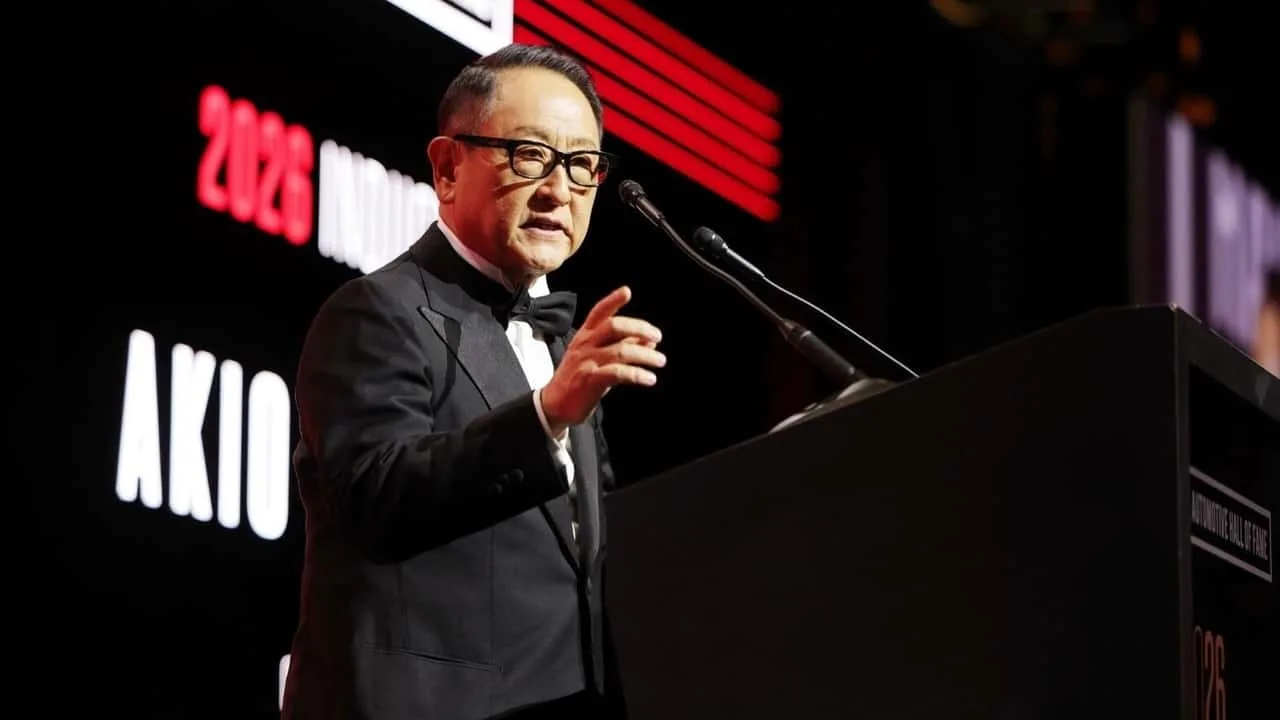
Akio Toyoda used his induction into the Automotive Hall of Fame on September 23, 2026, to urge automakers, suppliers, dealers, and motorsports professionals to work more closely together. Speaking to more than 700 people in Detroit, the Toyota chairman argued that collective effort could help the industry make a greater difference in people’s lives.
Toyoda’s induction also marked a rare family milestone. He became the fourth member of the Toyoda family to enter the Automotive Hall of Fame, joining his grandfather Kiichiro Toyoda, his father Shoichiro Toyoda, and Eiji Toyoda, his grandfather’s cousin.
Akio Toyoda joins an influential Hall of Fame
Greg Penske, vice chairman of Penske Automotive Group, introduced Toyoda by highlighting what he described as the executive’s courage to trust his own instincts. Toyoda responded by redirecting the attention away from himself and toward the people who helped shape his career.
“This honor really belongs to all of them,” Toyoda said, referring to his partners, employees, and customers. His induction brings Toyota’s total number of Automotive Hall of Fame honorees to five, with four coming from the same family.
The Automotive Hall of Fame has recognized automotive pioneers since 1939 and now includes more than 300 names. Its members include Henry Ford and Ferdinand Porsche. Motorsports engineer Giampaolo Dallara was also inducted as part of the 2026 class.
Toyoda’s call for industry cooperation
Family history was not the central focus of Toyoda’s speech. Instead, he asked companies across the automotive sector to place more emphasis on combining their capabilities and less on treating every other automaker as an opponent.
“Together, we have an extraordinary ability to make people’s lives better,” Toyoda told the audience. The message was aimed at an industry whose companies frequently compete for the same buyers, engineering talent, suppliers, and technology partnerships.
Toyota said the speech did not announce a new alliance or a specific joint project. Toyoda’s remarks were instead a broad argument for cooperation, delivered during one of the most significant moments of his career.
What the message could mean for automakers
Greater cooperation could eventually affect how automakers and suppliers develop vehicle hardware and software. Shared components, compatible systems, and common interfaces could help companies scale technologies and reduce duplicated engineering work.
That approach would also require automakers to agree on how shared systems are developed, tested, and validated. Safety and reliability would remain central concerns, particularly when multiple companies depend on the same underlying technology.
Toyoda has previously used public appearances to speak directly about Toyota’s priorities and the issues he sees facing the company. This speech continued that pattern, but its audience extended beyond Toyota: He called on the broader automotive industry to find more value in working together than in competing alone.